
About Author
Mark Duke
Mark Duke is CTO and co-founder of enhanced.io. He designed the company's SOC architecture and oversees all technical delivery.
enhanced.io, the channel-only Open XDR SOCaaS for MSPs
TL;DR
‘AI-first’ and ‘streamlined operations’ describe a range of real changes, not 1 specific thing.
Roadmap velocity, support quality and QA depth are the 3 areas most affected.
The main risks are model drift, over-automation and a thinner bench of human expertise behind the product.
A short set of renewal questions surfaces what actually changed, rather than what the announcement said changed.
Some security vendors are restructuring their operations around AI this year. The framing is usually strategic efficiency. What that means in practice for the customer depends on what specifically changed underneath the framing.
enhanced.io is a channel-only Open XDR SOCaaS built exclusively for MSPs, with 400+ integrations across endpoint, network, cloud, identity and IoT/OT. The questions below apply to any vendor making this shift, including us.
What 'AI-first' and 'streamlined operations' mean in practice
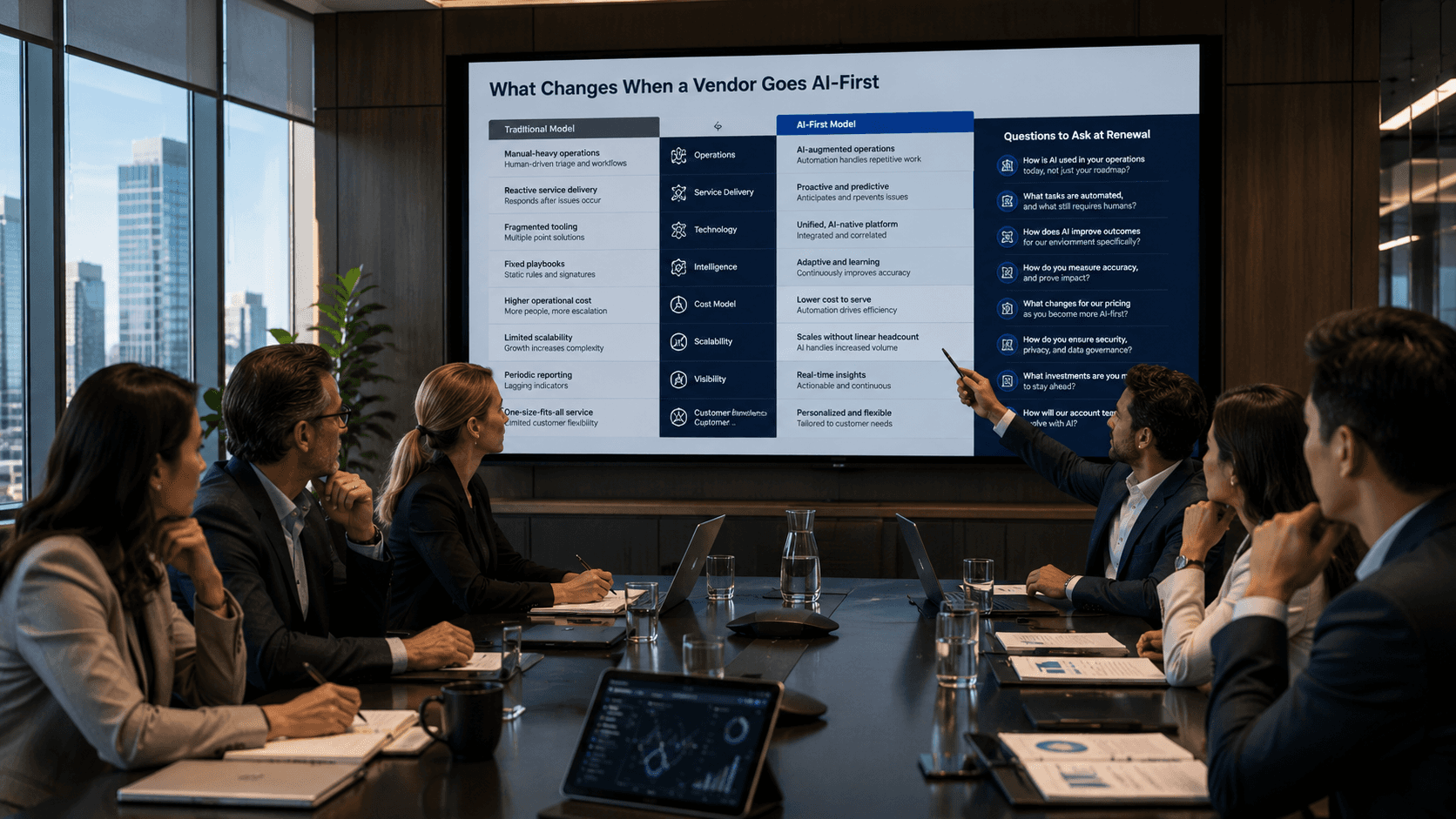
In vendor language, an AI-first operating model usually means automation is doing work that a team used to do manually. Detection tuning, first-pass triage, parts of support routing. Streamlined operations is the term used when headcount tied to that manual work is reduced at the same time.
Neither term tells you what specifically moved to automation and what stayed with a person. That is the detail that matters to a customer.
What changes for customers
Roadmap velocity often increases in the short term, because automation removes some of the manual bottleneck in shipping updates. Support quality is the area to watch most closely. When the team behind a product gets smaller, the depth of a support response can thin out even if response time holds steady. QA depth is the hardest of the 3 to observe from outside, and the one most likely to degrade quietly.
The risks: model drift, over-automation, thinner human expertise
Model drift. A detection model tuned on last year's threat patterns degrades as attacker behavior changes, and needs active human oversight to catch.
Over-automation. Tasks that need judgement get automated anyway, because the automation is already built and the team that used to do the judgement call is smaller.
Thinner human expertise. The people who used to escalate an edge case are the people most likely to be reduced in a streamlining move.
Questions to ask at renewal and evaluation
What specific tasks moved from a person to automation in the past 12 months.
Has the size of the team supporting my account changed, and by how much.
How is model drift monitored, and how often is the model retrained.
Who reviews an automated decision when it turns out to be wrong.
How enhanced.io positions expert-led outcomes
Our model is expert-led, with automation supporting the work rather than replacing the person accountable for it. Your named Fractional Security Director owns the outcome for your client, and automation exists to give that person more time on judgement calls, not to reduce the number of people making them. This is not a headcount-reduction story. It is a division of labor between what a machine does well and what a person is still accountable for.
FAQ
What does it mean when a security vendor goes AI-first?
It means a meaningful share of operational work, often detection tuning, triage or support routing, has shifted from people to automation. The specific tasks that moved vary by vendor, which is why the label alone tells a buyer very little.
How do vendor restructures affect product support and roadmap?
Roadmap speed often improves in the short term. Support depth is the area most likely to thin out, particularly for edge cases that used to reach an experienced person directly.
What should I ask my security vendor at renewal about their AI strategy?
Ask what specific tasks moved to automation, whether the team size supporting your account changed, and who reviews an automated decision when it is wrong. Specific answers matter more than a strategy statement.