

About Author
Kristian Wright
Kristian Wright is CEO and co-founder of enhanced.io, a channel-only SOC-as-a-Service provider built for MSPs. He has over 30 years in IT leadership and has co-founded three service delivery businesses.
enhanced.io, the channel-only Open XDR SOCaaS for MSPs
TL;DR
Vulnerability Management vs. Pen Testing vs. Threat Detection
Vulnerability Management is an ongoing, cyclical process of identifying, classifying, prioritizing and remediating software and system vulnerabilities using tools like scanners and feeds.
Penetration Testing is a point-in-time, authorized simulation of real-world attacks by ethical hackers who attempt to exploit weaknesses and assess how far they can breach your systems.
Threat Detection is about defending in real time-monitoring, detecting and responding to live threats and attacks as they emerge within your environment.
Together, these practices form a complementary security triad: prevention (vulnerability management), validation (pen testing) and active defense (threat detection).
Cybersecurity can feel like a crowded toolbox, full of overlapping tools, technical terms and blurred lines between responsibilities. For MSPs and MSSPs trying to expand their security services, it’s critical to understand the distinct roles that vulnerability management, penetration testing and threat detection play in a modern layered defense strategy.
These three approaches aren’t interchangeable, but they can complement each other when implemented effectively. We break down their differences, how each contributes to your clients’ security posture and how MSPs can package and deliver these services to grow recurring revenue, increase client value and stand out in a competitive market.
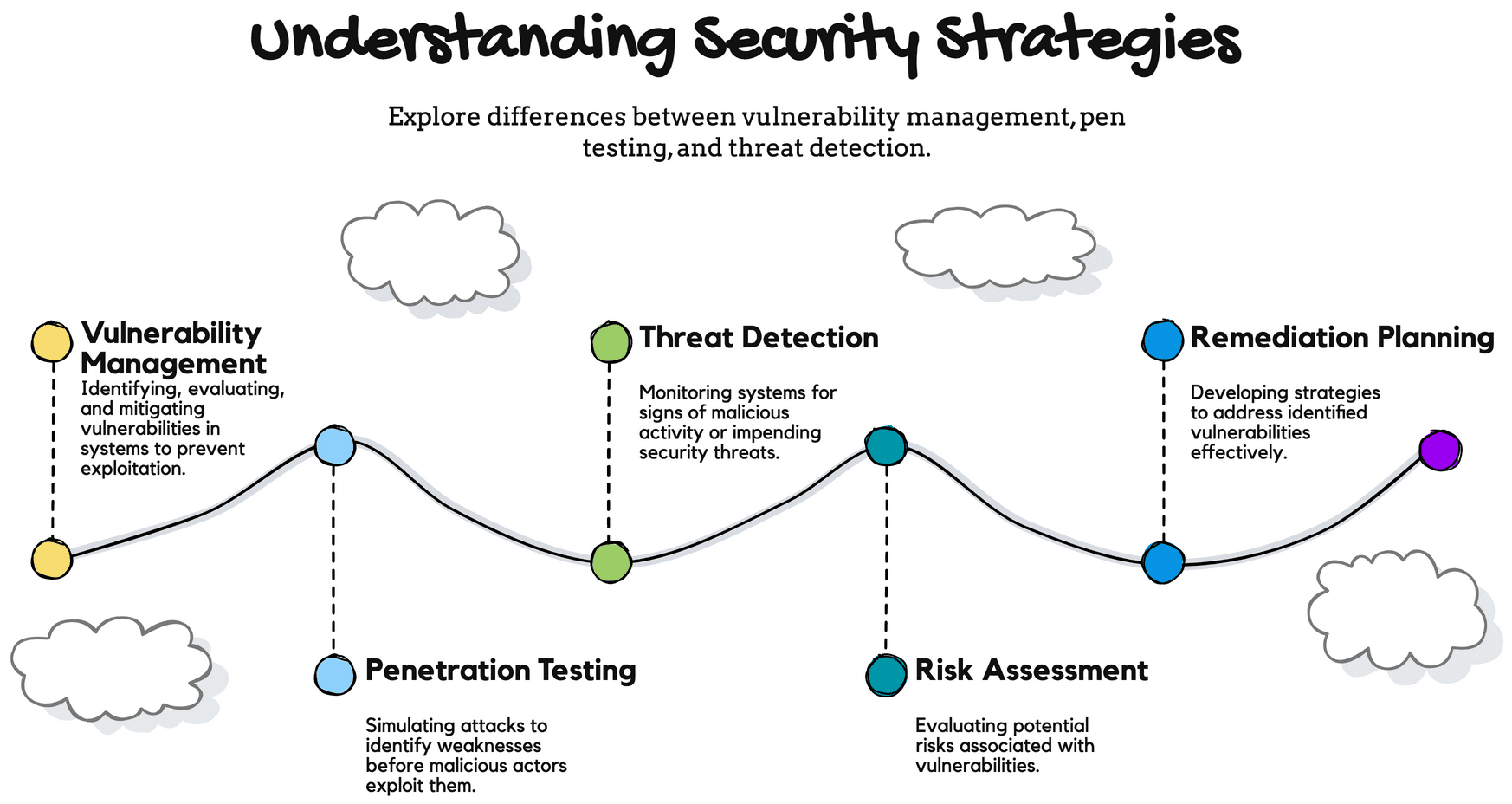
Vulnerability Management: Continuous, proactive risk reduction
Vulnerability management is the process of continuously identifying, assessing, prioritizing and helping to remediate security weaknesses across your clients’ IT environments. Unlike pen testing or detection tools that focus on simulated or real-time attacks, vulnerability management is ongoing and preventative, a critical foundation of cyber hygiene.
It typically includes:
Asset discovery
Regular vulnerability scans
Risk-based prioritization
Remediation guidance and tracking
Reporting and compliance support
Why MSPs & MSSPs should care:
Foundational protection: You can’t defend what you don’t know exists. Vulnerability management gives you and your clients clear visibility into risk.
Recurring value: Continuous scanning creates a service cadence that supports monthly reporting, accountability and conversations.
Easier compliance: Many frameworks like HIPAA, NIST and ISO 27001 require routine vulnerability assessments.
Low friction onboarding: Compared to advanced threat detection or manual testing, VM is easier to scale across multiple clients.
Penetration Testing: Simulating the attacker’s perspective
Penetration testing, or pen testing, is a simulated cyberattack carried out by security professionals (or ethical hackers) to uncover and exploit vulnerabilities in a controlled environment. It’s often used to demonstrate what an attacker could do if they found a gap in security.
It differs from vulnerability management in that it:
Is typically performed annually or quarterly
Involves manual techniques as well as automated tools
Focuses on exploitability rather than just identifying potential flaws
Why it matters:
Complements vulnerability management: Pen testing validates the effectiveness of remediation efforts and identifies gaps that tools might miss.
Great for awareness: Seeing how a real attacker might gain access often helps clients understand risks more clearly.
Required by some industries: Certain verticals (e.g. finance, government) or contracts may require pen testing for certification or insurance purposes.
Threat Detection: Identifying and responding to live attacks
If vulnerability management is about prevention and pen testing is about simulation, then threat detection is about live defense. Threat detection tools monitor endpoints, network traffic and user behavior to identify signs of compromise or active attacks as they happen.
It includes services like:
SIEM (Security Information and Event Management)
SOC as a Service or MDR (Managed Detection and Response)
Why it matters:
Real-time alerts: Catch threats before they spread or cause damage.
Faster incident response: Reduce dwell time with early warning signs.
Supports forensics and investigation: Helps with post-incident reporting and compliance.
High-value recurring service: Detection tools can create high-margin, managed service offerings for MSPs.
The Enhanced Defense solution integrates advanced threat detection capabilities alongside vulnerability management, automation and layered protection, all in one unified platform tailored for MSPs.
How these tools work together
Each of these approaches plays a specific role in a well-rounded security stack. Here’s a simple comparison:
Capability | Vulnerability Management | Pen Testing | Threat Detection |
|---|---|---|---|
Primary Goal | Prevent threats through visibility | Simulate and validate exploit paths | Detect and respond to live threats |
Frequency | Continuous | Periodic | Continuous |
Who Uses It | MSPs, security teams, auditors | Ethical hackers, consultants | SOC analysts, MDR providers |
Benefit to Clients | Reduces attack surface | Tests real-world exposure | Catches active breaches |
Positioning vulnerability management in your MSP offering
For MSPs looking to make a real impact on client security, without overwhelming their teams, vulnerability management is the smartest place to start.
enhanced.io s designed to help MSPs deliver proactive, scalable security by continuously identifying and prioritizing vulnerabilities across client environments.
Key features:
Agentless scanning or agent-based flexibility: Supports a wide range of environments, from cloud to on-prem.
Comprehensive asset visibility: See what’s connected, running and exposed at any time.
Risk-based prioritisation: Go beyond CVSS scores with actionable insights based on real-world exploitability.
Clear client reporting: Branded dashboards and remediation plans help you show ongoing value.
No extra burden on your team: Fully managed service by enhanced.io security specialists.
By embedding enhanced.io into your service stack, you can create high-value recurring revenue streams while delivering continuous improvement to your clients’ cyber posture.
A broader solution:
For MSPs and MSSPs ready to offer a complete layered security package, we bring together:
Vulnerability Management
Threat Detection
Response workflows
Risk scoring
Automated alerting and reporting
All in one easy-to-deploy solution, purpose-built for service providers.
Whether you’re just starting your cybersecurity journey or want to expand beyond reactive services, enhanced.io gives you the tools, visibility and automation to deliver results, without hiring or building a full SOC.
Start where you add the most value
You don’t need to offer everything to make a real impact.
While pen testing is valuable and threat detection is essential, vulnerability management is where MSPs and MSSPs can deliver immediate, visible and ongoing value. It’s also one of the most scalable security services you can offer, especially when powered by a fully managed platform like Enhanced VMS.
Whether as a standalone offering or as part of a complete defense strategy with Enhanced Defense, investing in vulnerability management is a powerful step toward becoming your clients’ trusted cybersecurity partner.
Listen to the podcast:
Vulnerability management, pen testing and threat detection explained



FAQ
What is vulnerability management?
Vulnerability management is the cyclical practice of identifying, classifying, prioritizing and mitigating vulnerabilities in systems using tools like scanners, threat feeds and remediation planning.
How does penetration testing differ from vulnerability management?
Vulnerability management highlights potential weaknesses via automated scans. Pen testing goes further by simulating real-world attacks-ethical hackers attempt to exploit those vulnerabilities to understand actual risk.
What is threat detection in this context?
Threat detection focuses on live defense: monitoring network and system activity in real time to detect, contain and respond to active threats-unlike the preemptive or testing-based approaches of the other two methods.
Why are all three needed?
Vulnerability management helps continuously harden your environment. Pen testing validates defenses through simulated attacks. Threat detection ensures you’re actively defended against real-time threats. Together, they provide a layered, resilient cybersecurity posture.
When should an organization prioritize each approach?
Use vulnerability management for daily or weekly hardening and compliance. Schedule pen tests quarterly or before major changes to validate security. Maintain 24/7 threat detection to guard against active, ongoing attacks.